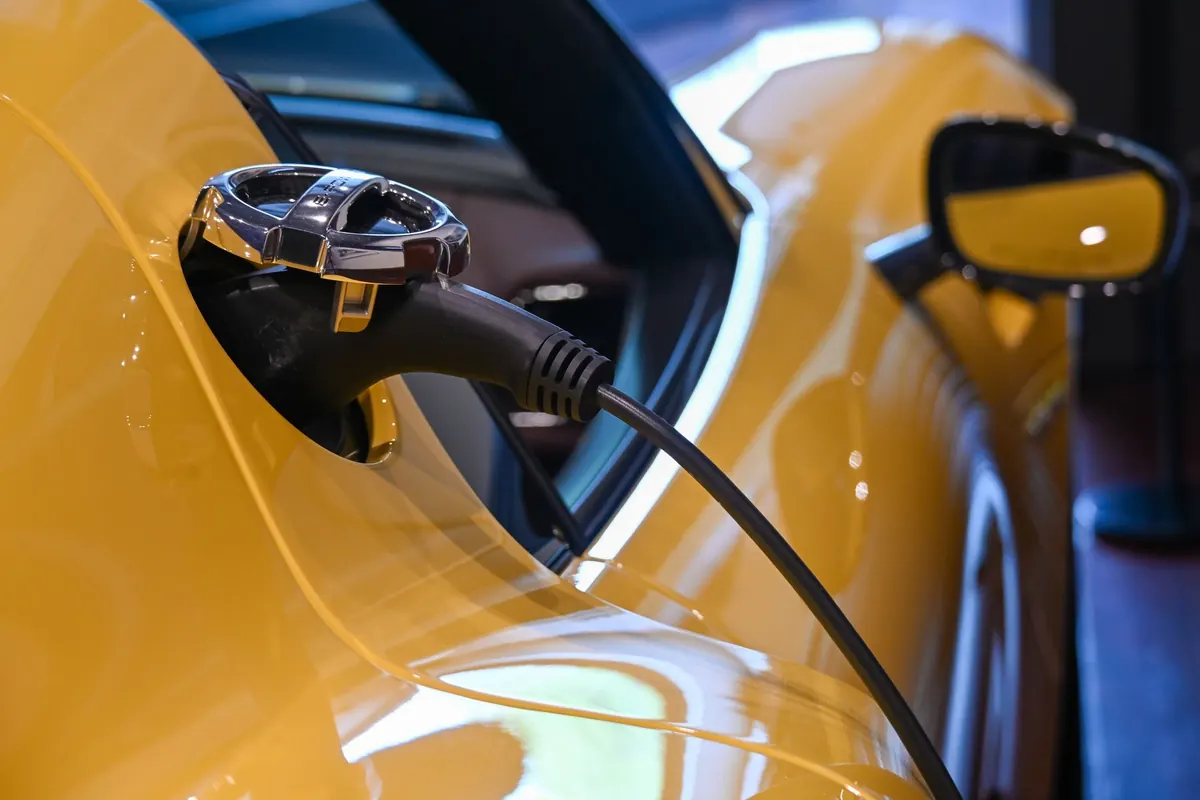
Ask most UK installers which metal belongs in an EV charging cable and they will answer before you finish the question: copper. For the flexible lead that plugs into the car, that answer is settled. Step back to the fixed wiring feeding a charge point, or to a submain serving a row of bays in a car park, and the choice gets less obvious. Aluminium has served British distribution networks for decades and can be the right call on the right job. It can also go badly wrong on the wrong one.
Where each metal actually ends up
It helps to split a charging installation into its parts, because the answer changes as you move away from the vehicle.
- The trailing lead and tethered cable: copper, without exception. Aluminium is brittle under repeated flexing and fine-stranded flexible conductors are made from copper for good reason.
- Fixed wiring to a single charge point: almost always copper. Runs are short, sizes are modest, and the material saving rarely covers the extra work at the terminations.
- Long submains and distribution to multiple bays: here aluminium deserves a serious look, especially where cable sizes climb above 25 mm².
- DNO service cables: frequently aluminium. Meter tails and consumer-side wiring are normally copper.
Conductivity: aluminium needs a bigger cross-section
Aluminium conducts roughly 60% as well as copper for the same cross-sectional area. To match copper's resistance, you need about 1.6 times the area. A 16 mm² copper conductor has an aluminium equivalent around 25 mm²; 25 mm² copper pushes you towards 35 or 50 mm².
Two consequences follow. First, voltage drop calculations have to be redone rather than copied across. BS 7671 sets voltage drop limits — broadly 3% for lighting and 5% for other circuits on a public supply — and those limits bite harder on long runs, which is exactly where aluminium tends to appear. Second, the cable gets fatter. Containment, trunking, ducts, gland plates and cable tray all need to accommodate a larger overall diameter, and that cost belongs in the comparison.
Weight and handling
Aluminium is far lighter than copper — roughly a third of the density. Once you adjust for the larger cross-section needed, an aluminium conductor of equivalent resistance still comes out at about half the weight of its copper counterpart.
On a 60-metre submain to a car park distribution board, that difference is felt. It means easier pulling through ducts, less load on tray supports and structures, and less strain on gland plates and enclosure fixings. On a short domestic run it means nothing at all.
Cost: look at the whole installation
Aluminium is cheaper per tonne, and copper prices swing more sharply on the metal exchanges. But the gap per metre is narrower than headline metal prices suggest, because you are buying more volume of aluminium to do the same job.
Then add the items that only appear with aluminium: larger glands, bimetallic lugs, oxide-inhibiting compound, potentially a re-torque visit, and more labour time per termination. Aluminium tends to win commercially at large sizes over long distances, and lose on short domestic work. Availability matters too — not every wholesaler stocks the aluminium size you need, and a special order can wipe out the saving.
Terminations: where installations succeed or fail
Loose or corroded terminations are a leading cause of electrical fires in charging equipment, and aluminium is less forgiving than copper on both counts. Aluminium oxidises instantly in air, and the oxide layer is an insulator.
Good practice with aluminium conductors means:
- Wire-brush the conductor and apply a suitable oxide-inhibiting compound before terminating.
- Use connectors rated for aluminium, or bimetallic lugs where aluminium meets copper.
- Torque to the manufacturer's figure with a calibrated tool, and record it.
- Re-check torque at the first maintenance visit — aluminium creeps under compression and joints can slacken over time.
- Keep joints dry. Aluminium corrodes readily in damp conditions, which the UK has in abundance.
Allow generous bend radii and check that the enclosure, gland plate and meter cabinet have room for the larger cable. Copper-to-aluminium contact without a bimetallic barrier invites galvanic corrosion, particularly in coastal or chloride-exposed locations.
What UK regulations allow
BS 7671 does not prohibit aluminium conductors, but its standard current-carrying capacity and voltage drop tables are built largely around copper. If you specify aluminium, you will generally be working from the cable manufacturer's tabulated data, with conductor requirements referenced to BS EN 60228, which covers both metals.
For EV work specifically, the IET's Code of Practice for Electric Vehicle Charging Equipment Installation is the reference most designers and installers follow. It is not legislation, but it carries weight as evidence of good practice. In England and Wales, charge point work in dwellings falls under Part P of the Building Regulations, with different notification arrangements in Scotland and Northern Ireland.
Note that charge point earthing requirements — including protection against a broken PEN conductor on TN-C-S supplies — apply regardless of which metal you choose. Changing conductor material does not remove the need for that design work. In commercial settings, the person signing off the design must be competent to do so; if that is not you, bring in a qualified electrical engineer before the cable is ordered.
Choosing in practice
Work through the job rather than the metal price:
- Anything that flexes: copper. No exceptions.
- A single domestic charge point on a short run: copper. The saving will not survive the terminations.
- A long submain or a board feeding several bays: price both properly, including containment, glands and labour.
- Aluminium specified: confirm the correct lugs and compound are on site before the cable arrives, and schedule the re-torque visit.
- Either material: leave terminations accessible so they can be inspected later.
Also check the charge point manufacturer's installation instructions and any warranty conditions before deviating from copper tails — some specify a maximum conductor size at the terminal or ask for a particular termination method. A few minutes reading the manual is cheaper than replacing a unit at your own cost.
The question is not which metal is better. It is which one suits the run, the enclosure, the environment and the person who will open that cabinet in five years' time.
Photo: Beth Fitzpatrick / Pexels